About this
This project considers how basketball players became great in the past, and how they become great today.
Basketball didn’t use to be about likes, or number of followers.
What does it mean now that it is?
The answer matters beyond sports.
That’s the reason for this project: Room for all, in all Rooms.
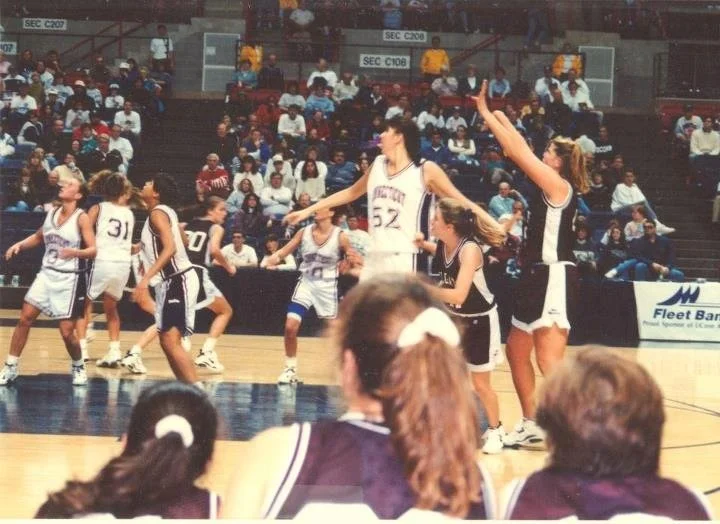
source for photo: private family archive, courtesy of its owner
Watching the NCAA tournament this year after my first year coaching girls’ basketball at the high school level, I started putting things together. Thirty years of manager research investment experience across different continents and organizations, parenting, working, coaching, I was noticing a strange dichotomy: more and more talk about the importance of process over outcome, learning from mistakes, understanding human biases, but less accountability and less willingness to endure the discomfort required to actually integrate feedback.
When Michigan won the men’s tournament with its “first year” roster while the Tennessee women’s basketball coach Kim Caldwell lost her entire roster to the transfer portal, I realized something in basketball had permanently shifted. Roster turnover had become normalized, with skill development and teamwork the casualties.
The commitment I recognized was gone. As I looked to understand what had taken its place, I realized I had to first acknowledge and define what I myself had gained.
Growing up I actually didn’t start playing basketball until 7th grade. Before that I had been living overseas because of my dad’s job as an economist at the World Bank. So when I arrived at McLean High School, Coach Fred Priester saw, quite literally, a big project. Almost 6’0” but I barely knew how to pivot and had little of the elegance basketball players are known for. Nevertheless, I had already grown to love the sport and also loved the sense of belonging it gave me, especially as a newcomer to public school.
Coach Priester was not easy. He got in your face. He yelled. We ran. But he explained why, early and directly: he pushed us because he saw what we were capable of and refused to let us be less than that. He cared about us through the game of basketball. It was a special kind of message for a high school student, really. Not criticism, but loud and visible expectations. He was from Indiana; this was the Bobby Knight era. Focus on defense, fundamentals, discipline, team. We watched film; assistants kept detailed statistics for every game. He sent handwritten notes through the school mail system. “Tonight is your night to shine,” “Hit the Shots”. “Defense wins.” The combination was not incidental. High standards; attention to detail; personal contribution; team success. He told us we were special, and we were, because he made us that way. Six days a week, 2+ hours of practice a day, October to February.
Our culture was real. I put in the time. I was rewarded: JV Award, Most Improved, MVP. The awards mattered not because of individual accomplishment but because of what they represented: the commitment and work I had put in, starting much later than my teammates, now in the hockey stick phase of my improvement. We were not special as athletes, but we loved the sport and we loved our team. We had a successful season, finishing better than expected though falling short of the District championship in what was a competitive field and region. Looking back, it’s clear that what Coach Priester was creating was more than just skillful players, he was developing skillful people - people with the resilience and capacity to grow and learn through challenge and difficulty.
College basketball, by comparison, was a disappointment which only made me even more grateful for the high school experience I had had. After my freshman year we got a new coach, former assistant, first year head coach. I wasn’t a scholarship athlete and she saw me as lacking effort and commitment. It was a painful experience and a particular kind of 180 after Coach Priester’s approach. Despite being devalued and underutilized I didn’t really think about transferring; I was otherwise committed to Colgate and our team. But, basketball stopped being fun, I even quit for half a season. But I realized I wouldn't be happy with myself if I didn't keep going. I had to show her that she couldn't get rid of me so easy. I’d learned from Priester - the experience wasn’t hers to take away.
In the meantime, Coach Priester left McLean for Oakton before the 1994-95 season. He has since accumulated more than 800 wins over the span of his career. His 2012 team went 31-0 and won the state championship. He was inducted into the Virginia High School Coaches Hall of Fame in 2024. His players have played across all college levels, overseas, and in the WNBA. Last year, still coaching Oakton, he took his team to the state semifinals where the star athlete is going on to play D1 softball in the Patriot League. His decades-long commitment to elevating high school girls’ basketball, prioritizing the slow, unglamorous work of development, deserves deep appreciation..
Many people understand the value of sports; what I'm saying is not controversial. We play for many reasons. But perhaps less well documented is what happens to us because we play. These practice environments, where you are learning something new, trying it, and failing, then trying again, are worth a lot. They create resilience and capabilities that transfer.
But why? What makes some learning environments truly special?
The first requirement is personal investment in the outcome. You have to care. Practice is deliberate and repetitive, and not designed for your enjoyment. Feedback is direct, visible to your peers, and unambiguous. Mistakes become data, and repetition creates self-correction. By integrating a coach’s guidance, and eventually getting it right, you learn that self-belief and effort matter. You know that keeping the bigger picture in mind is what carries you through the tough stretches and those quiet bus rides home.
What is being built, across all of those repetitions, is not just skill. It is something harder to name and harder to measure. You are developing the ability to take feedback, correct, and self-correct: to look at what just happened, figure it out, and adjust. You are learning that mistakes aren’t verdicts, they are data. You are learning accountability. You are learning that people and skills are complementary, not substitutes for one another. Everyone has a role and the best teams play to people’s strengths and not their weaknesses.
When you subordinate your desire in the moment - whether that is rest, an easier path, or recognition, to what the team needs, you demonstrate your belief in the value of the formation experience. Joining a team is essentially signing up for constant correction. Learning a new skill takes time. You have to believe that it is worth something later, even if you can’t see it at the time. This is intangible human capital: formation capital.
None of this shows up in a box score. None of it is easily observed from the outside. But it is precisely what makes the difference, later, in environments that are ambiguous, demanding, and unforgiving — which is to say, in most environments.
Formation capital: the accumulated capacity that comes not from talent alone, but from repeatedly incorporating external feedback, correcting, and learning to self-correct—especially when doing so is difficult and uncomfortable.
But if the NIL and the transfer portal are devaluing this kind of formation experience, the bigger question becomes: where do people learn how to take feedback, correct, and keep going?